
Content
The Konix Multi-system Games
Here are the know games that were either in development for the Konix Multi-system or had been planed to be. Some have screen shots from magazines and some have videos provided with kind permission of Jon Dean (the guy that actually filmed them). Please don't distribute or re-produce these videos as they remain Jon Dean's Copyright.












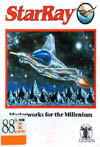



Revenge of Starglider

Starglider
Argonaut Software
The lost Konix port whose code became the catalyst for Star Fox. The polygon engine Argonaut Software wrote for the Multi-system in 1989 evolved into the Game Boy 3D demos that got Nintendo’s attention — and then into the Japan-only Game Boy title X. By Jez San’s own account, that body of work is what convinced Nintendo that 3D belonged on their consoles, and led to the phone call (made from inside a Kyoto meeting room) that started the Super FX. With Star Fox returning to Switch 2 on 25 June 2026, that British thread is worth retracing.
Star Fox arrived on the SNES in 1993 as a Nintendo flagship — a polygon dogfighter running on a dedicated co-processor chip called the Super FX. The story most retrospectives miss is what happened in the four years before that, on a British console that never sold.
In 1989, Argonaut Software were quietly writing 3D code for the Konix Multi-system: a polygon rasterizer running on the system’s 12-bit sound DSP, feeding display lists to its blitter chip. The programmer was Dylan Cuthbert, then 18. The chipset he was running it on was designed by Ben Cheese of Flare. That code didn’t ship — but the polygon technique behind it did, three times over: first on a Game Boy demo that opened Nintendo’s door, then in the 1992 cult title X, and ultimately on the Super FX chip Ben designed to put 3D inside an SNES cartridge.
At a glance
The game it was meant to be
What we know about the intended game is sparse but suggestive. It would have been a port of Starglider — Argonaut’s existing 3D dogfighter, available at the time on Amiga, Atari ST and PC — taking advantage of the Multi-system’s 3D capabilities. Combined with the Konix Power Chair, it could have offered something genuinely immersive. According to its press release, it would also have been the only Konix game to support the helicopter add-on.
Revenge of Starglider! (Development title)
(Expected availability February ’90) New and original flight simulator and arcade game in one, taking advantage of all of the features offered by the Multi-System. Written by Argonaut Software. Also works with Konix Power Chair.
Dylan Cuthbert at Argonaut
The full story of what Argonaut were actually doing on the Multi-system surfaced in conversation with Dylan Cuthbert, who at 19 was developing the polygon rasterizer that would have driven the game. He went on to work for Nintendo on Star Fox itself, and now runs Q-Games in Kyoto.
Testimony · Dylan Cuthbert
At Argonaut Software I started developing a polygon rasterizer using the Konix Multi-system’s sound DSP (which was a 12-bit CPU and kind of interesting), and had it creating the display lists that were then used by the system’s blitter chip to render the polygons.
I had got all this working when the programmer who was contracted to develop a bike racing game for the system (Chris Walsh, I think his name was) suddenly left that project. This led me to have to take over and develop it properly into a playable demo, which I did, and it was then shown at the ECTS show when the Konix system was shown to the public.
Unfortunately I have no material from those days as it was all left at Argonaut, and of course Argonaut is no more. It was a very long time ago, and I was soon swept up into Nintendo work. I do remember meeting Jeff Minter at ECTS though, and us having a laugh with that game chair they were also thinking of selling.
My polygon engine would have been the start of a Starglider game I think, but that was scuppered with the mid-project change above. I ended up using the know-how when I moved to the Game Boy to develop “X” (or Eclipse as it was called when it was being funded by Mindscape). X was before StarFox, and a lot of the ideas from there seeped into Fox of course. X was only released in Japan, but recently I had the pleasure to make a sequel — you can play that on DSiWare, it’s called “3D Space Tank” in Europe (but X-Returns in Japan, where obviously using the name X made a lot more sense).
Dylan Cuthbert — Argonaut Software → Nintendo → Q-GamesHow X opened Nintendo’s door
Dylan’s Konix polygon work didn’t die when Konix did. The technique he’d developed for the Multi-system migrated, more or less wholesale, onto the Game Boy — where Argonaut used it for the demo that got them in the door at Nintendo of America. That demo was paired with one of the most famous bluffs in industry history: Argonaut had broken the Game Boy’s copyright protection with a handful of cheap components, making the boot screen briefly read “Argonaut” before reverting to “Nintendo” at the second check. They walked it up to Nintendo’s stand at CES, found Don James (the most senior Nintendo employee they could locate), and showed him both the hack and the 3D running on a monochrome handheld. Shortly afterwards, Jez San was on a plane to Kyoto.
The Game Boy 3D demo that won that meeting became, in 1992, the Japan-only Game Boy title X (codenamed Eclipse during its earlier Mindscape-funded phase) — widely cited as the first 3D game on a handheld console, and a direct creative ancestor of Star Fox. The Konix-era polygon know-how is what made it possible.
According to Dylan, the meeting that kicked off the Star Fox project happened in Kyoto in July 1990. Miyamoto showed the Argonaut team a prototype of Pilotwings — which already had a small DSP chip in the cartridge to do perspective calculations — and admitted he was disappointed it still couldn’t rotate the sprite-based aircraft properly. Sitting across a room from Miyamoto, Gunpei Yokoi, Takehiro Izushi and a dozen other Nintendo luminaries, Jez San reached for his phone, called Ben Cheese, and started the conversation that would become the Super FX. Ben — as Jez would later put it — was a contact from “the Konix days”.
Ben Cheese and the Super FX
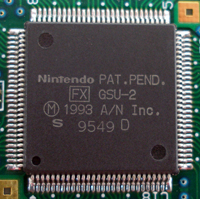
Super FX
Inside Star Fox cartridges
The hardware thread runs through one person. Ben Cheese was a founding member of Flare Technology — the team that designed the Konix Multi-system’s Slipstream chipset Dylan was writing for. He had also worked at Sinclair Research, and Jez San has been explicit on the record that those Flare and Konix years are precisely where he knew Ben from when the chip discussion began.
The chip Ben designed — codenamed MARIO internally, and shipped as the Super FX in 1993 — wasn’t a 3D accelerator in the way later GPUs would be. Argonaut built it as a full RISC microprocessor with maths and pixel-rendering instructions, with the software written first and the instruction set tailored to it. It is generally credited as the first GPU shipped in a games console, and for several years was one of the best-selling RISC chips in the world. It sat inside the Star Fox cartridge itself, ran the polygon engine, and pushed performance roughly forty times beyond what the SNES CPU could manage alone.
None of that happens without the call from the Kyoto meeting room. And that call doesn’t happen without the Konix-era hardware relationships behind it. The Super FX is, in a meaningful and traceable way, downstream of the Slipstream.
Ben Cheese sadly passed away in 2001.
The lineage
Two threads, both starting on the Konix Multi-system in 1989, converging in Star Fox four years later.
From Konix to Star Fox · 1989 → 2026
Slipstream chipset designed at Flare
Ben Cheese · co-founder, Flare Technology
Custom 3D-capable chipset built for the Konix Multi-system: 12-bit sound DSP, blitter, ASIC. The hardware Dylan would shortly be writing for — and the project where Jez San first knew Ben.
Polygon rasterizer on Konix DSP
Dylan Cuthbert · Argonaut Software, age 18
Cuthbert writes a polygon rasterizer using the Multi-system’s sound DSP, feeding display lists to the blitter. The technique he develops here is the seed of everything that follows.
Game Boy 3D demo + copyright hack
Dylan Cuthbert / Jez San · Argonaut
The Konix polygon technique is ported to the Game Boy. Paired with Argonaut’s famous Game Boy boot-ROM bypass, it becomes the demo Jez San uses to talk his way past Don James at CES — and then onto a plane to Kyoto.
The Kyoto meeting
Jez San, Dylan Cuthbert · Argonaut · with Miyamoto, Yokoi et al.
Miyamoto shows Argonaut a Pilotwings prototype struggling to rotate sprites. From the conference room, Jez phones Ben Cheese — “from the Konix days” — to begin the conversation that will become the Super FX. Both threads of the Konix story are now firmly inside Nintendo.
X (a.k.a. Eclipse) on Game Boy
Dylan Cuthbert · Argonaut, funded by Mindscape
The Game Boy 3D demo ships as X — Japan only, widely cited as the first 3D game on a handheld. A direct creative ancestor of Star Fox.
Super FX chip ships
Ben Cheese et al. · designed by Argonaut for Nintendo
Codenamed MARIO. A custom RISC processor baked into the SNES cartridge itself — widely credited as the first GPU in a games console. Roughly forty times the 3D performance of the SNES CPU alone.
Star Fox / Star Wing on SNES
Argonaut Software for Nintendo EAD
Both threads meet. Dylan is on the programming team; Ben’s chip runs the game. Sells over 4 million copies. Defines Nintendo’s 3D credentials for the SNES generation.
X-Returns / 3D Space Tank (DSiWare)
Dylan Cuthbert · Q-Games
Dylan’s own sequel to X, made two decades after the original. The polygon thread that started on the Konix carries through to the modern day.
Star Fox returns on Switch 2
Nintendo · cinematic remake of Star Fox 64
A reboot of the franchise whose technical and creative DNA traces back to polygon code written for a British console that never shipped.
“We taught Nintendo 3D games and left them a permanent legacy.”
Jez San — founder, Argonaut Software · speaking to Time Extension, 2023Update — Chris Walsh on the port itself
After talking with Dylan, I managed to reach out to Chris Walsh, who could share information on what porting Starglider proper to the Multi-system would have looked like.
Testimony · Chris Walsh
In theory it wouldn’t have been that much work to get it running, as there was already a version on PC. The main bulk of the work after that would have been getting the 3D transforms and polygon rendering taking advantage of the DSP and blitter to run at a decent speed.
Sadly, I never did get to have a go on the chair, or even see one! Have you tracked down any footage of a real one working?
Chris Walsh — Argonaut SoftwareCould the Multi-system actually have run Star Fox?
A separate question: even if the lineage is clear, could the Multi-system hardware itself have delivered something like Star Fox? When I asked asked Fred Gill of Attention to Detail — One of the studios most familiar with the machine, he put the figure surprisingly low.
“I reckon you’d have gotten about 5fps with Star Wing / Fox.”
Fred Gill — Attention to DetailFred may have been understating it, ATD’s own Multi-system demos showed more 3D potential than 5fps would suggest. But factoring in everything a game has to do on top of a 3D engine, he may have a point. Realistic playable fps would start somewhere around 15–20, so even an optimistic ceiling would have left the machine short of a true Star Fox-equivalent. As a port of Starglider the original game though — simpler scenes, fewer enemies — it was almost certainly within reach. We just never got to see it.
Screenshots
No screenshots of the Konix version of Starglider are known to survive. The images below are from the Amiga version of Starglider II — included as a visual reference for what Argonaut were working from when the Multi-system project began.
Starglider II · Amiga screenshots (reference)
)
)
Note: these are Amiga screenshots, not Konix. No imagery of the Konix demo Dylan describes is known to exist. If you ever worked on or saw the polygon demo at ECTS 1989/1990 and have anything at all — screenshots, photographs, even hand-drawn sketches — please get in touch.
Sources & further reading: The Jez San and Dylan Cuthbert recollections of the Kyoto meeting, the Game Boy copyright hack, and the technical detail on the Super FX chip are drawn from Damien McFerran’s feature “The Making of Star Fox — We Taught Nintendo 3D Games And Left Them A Permanent Legacy” on Time Extension (republished 2026; originally Eurogamer). Dylan Cuthbert’s quotes about the Konix-era polygon rasterizer and the ECTS demo, and Chris Walsh’s note on a hypothetical port, were given to this site directly.