
Content
MSU
Who or what is MSU?
MSU stands for Multi-system UK. This distinction needs to be made so that it's clearer that when we talk about MSC - Multi-system China elsewhere in the website, that we know that MSC was only set-up to sell the unused Konix Multi-system Controller shells as a PC joystick and nothing else. As far as I know MSC existed for no other purpose.
MSU is a company that rose Phoenix like from the ashes of Konix after Konix had collapsed trying to bring the Multi-system to market.
MSU was run by mostly the same people and used the remaining technology from the attempt to build the Multi-system. Instead of going all-in and creating another version of the same machine, MSU recognised that they had a marketable System on a Chip (SoC) which could be further developed and combined with other chips to create the basis of a system that could be licensed to other electronics manufacturers.

MSU Office
Milton Keynes

MSU office
Plano, Texas
MSU originally had two offices - one in Sheffield, and one in Milton Keynes, but they later closed the Sheffield office and moved some of the staff to the Milton Keynes branch.
It seems in the long term that despite initial efforts to hit the ground running with a successor to the Multi-system, MSU didn't seem to have the same drive to build a games system as Konix did, or at least that drive diminished after an initial flurry of activity which used talented Developers, Artists and Musicians. There was still a lot of stigma from the failed launch of the Multi-system. I believe there came a time when MSU must have realised they had lost the battle and decided to stop fighting the industry Giants and went of in a different direction.
MSU existed from March 1992 to roughly 2003 before getting sold off to an American company.
MSU gradually grew into a company with a very clear drive to jump on the internet Bandwagon by creating it's internet device and seemed to give up on any gaming / generic entertainment device notions.
From the MSU website:
In January 2001, we moved our headquarters from Milton Keynes, United Kingdom to Plano, Texas, a suburb of Dallas (we maintain an office in Milton Keynes to continue marketing our products in the United Kingdom and to support customers who purchased previous versions of the internet access device)
Although MSU wasn't a household name like Konix, they are very much the continuation of Konix under a different name and with a slightly different approach.
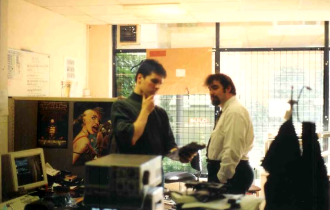
Keith Goodyer and Steve Logue in the
MSU R&D lab - Milton Keynes
Producing a games machine takes a great deal of highly specialised effort. If this effort has already been applied by someone then other companies without that specific expertise (but good manufacturing capabilities) can license the technology and adapt it to suit their needs. This drastically reduces the time and cost of getting a machine to market.
This effort had already been expended in the form of creating the Konix Multi-system. Spending time strengthening what they had, MSU was changing it's business strategy and becoming somewhat more anonymous in the process. This may have been an intentional decision - trying to shy away a little from all the attention and to shake off some of the stigma of failure would go a long way to ensuring other companies you deal with would be keen to keep dealing with you. Creating a chipset that is licensed to other manufacturers proved to be a fruitful activity.
But there's more to the story than just this. At the heart of MSU were people working very hard to develop a working sale-able system. It's reported that the latter versions of the Slipstream chipset were not very reliable and Programmers and Artists struggled to get it to perform as well as it should. Add to this a sense that the personalities that lead to the decline of the Konix were causing similar problems for those involved in the new venture.
I think it's a good idea to point out that MSU wasn't just Wyn Holloway.
In fact, Konix was run by Robert Kent and Wyn Holloway and by the time of MSU
Keith Hall was also part of the management team.
To the best of my knowledge, MSU comprised the following people: (thanks to
Keith Goodyer for the list)
- Wyn Holloway
- Keith Hall - Managing Director
- Christian Armstrong - PA to the Directors
- John Watts - Head of R&D
- Mike Baxter - Marketing and PR
- Robert Kent - Senior Hardware Architect
- Keith Goodyer - Product Development Manager
- Martin Brennan - ASIC Designer
- Christian Pennycate - Senior Software Engineer
- Geoff Philips - Software / Hardware Test Engineer
- Wayne Maw - Software Engineer
- James Marshal - Hardware Designer
- Steve Logue - Software Engineer
- Ken Jarvis - Graphics Designer
- Paul Blythe
- Andy Mucho
- Fiz Mohammed
- Paul A Bellamy
- Alick Morall
- Chris Kenny
Myth of the Multi-system 2?
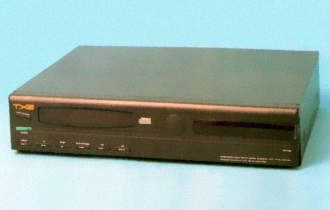
The TXC Manufactured 'TXE Multi-system'
- effectively the Multi-system 2
from Edge magazine in April 1994
There seems to be some doubt floating around the internet about the existence of a Multi-system 2. Let's set this straight now: There was no Multi-system 2. What you can say though is that several products were created based on an evolution of the Slipstream chipset and sold as a functioning system to hardware manufacturers around the world. Newstar Electronics, TXC, Yanion and IBM were all clients of MSU. Except for IBM whose joint product with MSU didn't get to market (more about that further down the page), the Slipstream chipset was commercially available, although it's hard or even impossible to get your hands on any tangible physical units.
Although listed on the MSU web site as a VCD player, the TXC system was also being pitched as a games system and software was certainly being prepared for it. Despite the chosen use of the chipset and the manufacturer, the system was capable of being used for one two or more applications such as CD player, photo CD viewer, Video CD player, Games Console and Karaoke player.
So, was there something we can at least call a Multi-system 2? Well,
effectively yes although it wasn't really being sold as a the successor to
the Konix Multi-system. Was it vapor-ware? No - Supposedly you could have walked into an
Asian electronics supplier at the time and bought one.
Was it a commercial failure? - I have no idea how many were sold and how
popular they were, but let's just say, it didn't exactly set the world
alight.
Was this machine a great Games Machine? In the face of strong opposition from the then new Playstation it would have needed to have been spectacular but by then, unfortunately it wasn't.
It's already been reported in the Retro Gamer issue 8 article that Brian Pollock declined the invitation to move out to China and help train a team of programmers in the ways of (what I'm calling) the Multi-system 2.
After reading the following account he may have made the most sensible choice of his life, and until now he may not even have realised how lucky he was to escape.
The following account has been given to me completely unsolicited and based on the quality and accuracy of the information, I can only assume this is an honest account of the recollections of the person involved. The source wishes to remain anonymous for obvious reasons. Therefore I have intentionally edited out specific names other than Wyn's. It certainly paints a less rosy picture of the whole affair.
Read about his Multi-system 2 system development experiences here
I'm led to believe that Wyn Holloway tried to promote the TXC Multi-system on a TV gaming show - but he denied this when I interviewed him, and as I don't know what show it was I can't hunt for footage. It was some kind of Computer games show running on Sky TV in the UK.
However, I now know thanks to members of the MSU Multi-system Development team, that the BBC Money program ran a story about MSU in which the team appear. Unfortunately the BBC Archives for the Money program only go back to 2006 (a friend at the BBC checked for me). So unless someone involved kept a VHS copy, we may never see actual footage of the machine or the games running on it.
So, what was it like?
To be honest - it's shockingly dull. It looks to be styled as a Hi-Fi separate or a set-top-box rather than a games machine, but this may just have been merely sufficient to keep the electronics contained. We know Wyn could come up with some elaborate designs, so if this were to have become a mass produced item, it may have received a little more effort in it's design. However, it's patently clear that there is no effort to adopt the Slipstream controller in any way what-so-ever. I also believe that no Konix peripherals such as the Power Chair or Light Gun were intended to be used with it either.
I assume the remote could be used as a controller. There may have been wired controls or even wireless controls. Unless more information turns up or a final unit - we'll never know. I suspect however it used just a remote control.
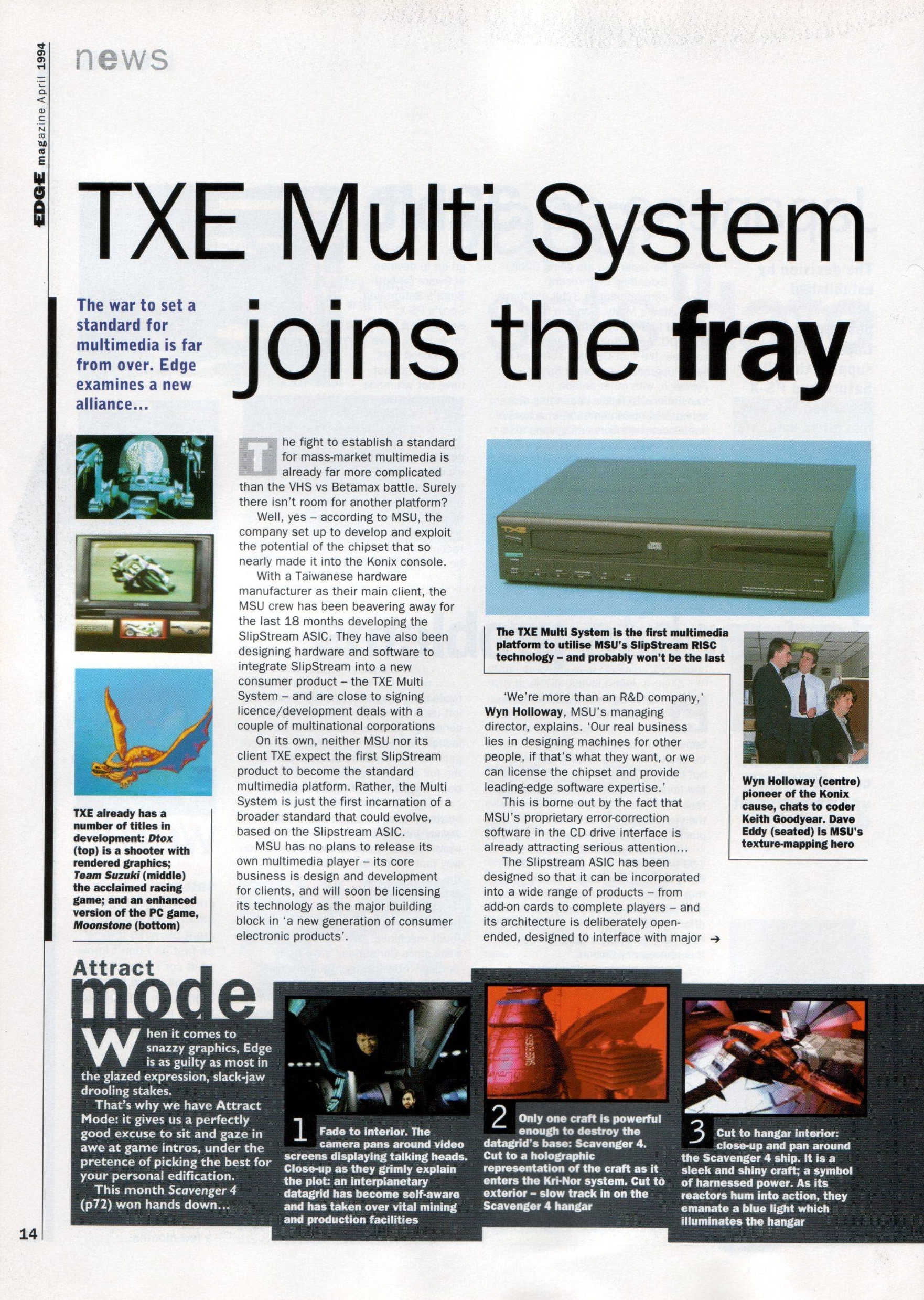
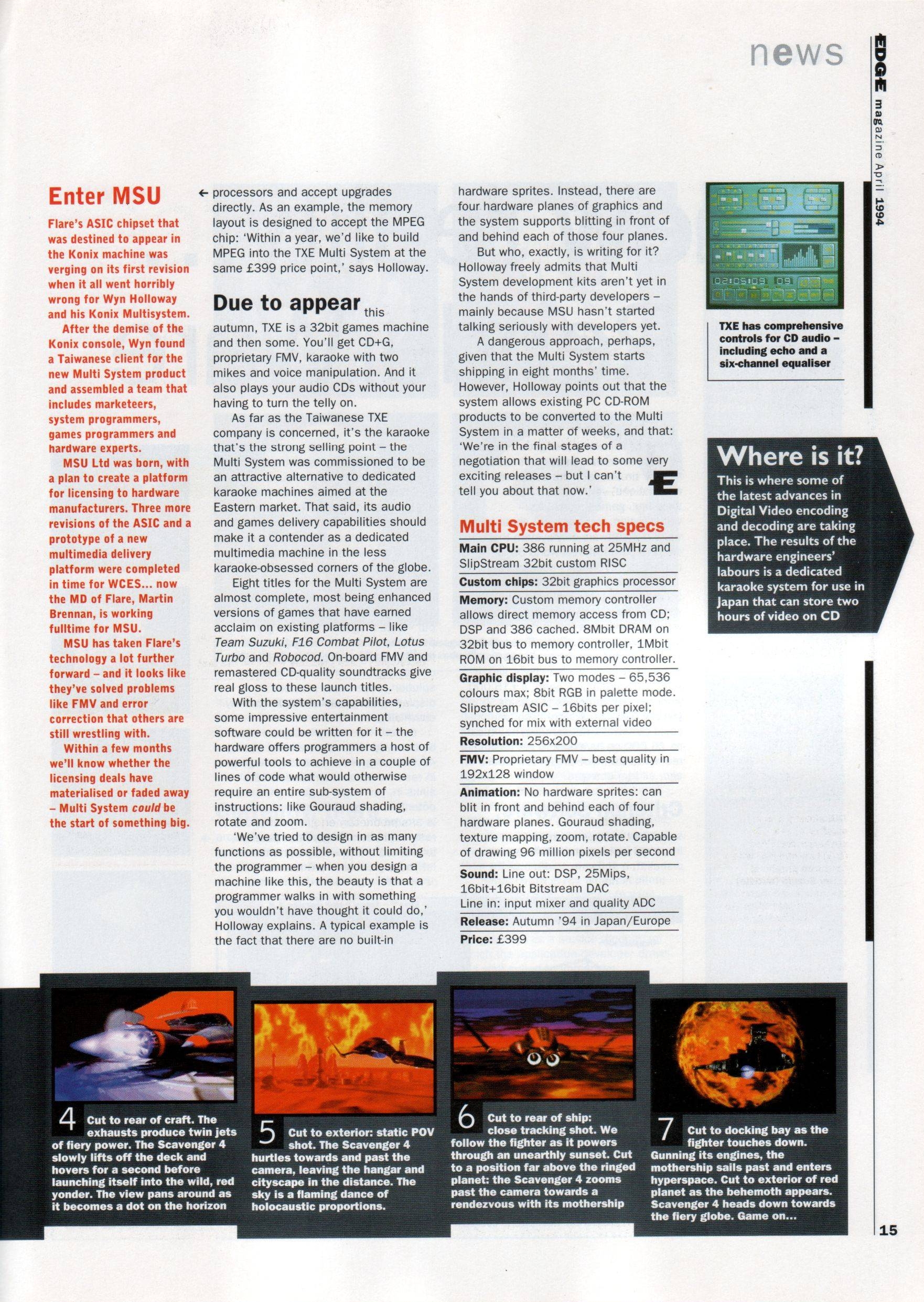
As you can see thanks to this recently re-discovered magazine scan, the Multi-system 2 was very much being worked on, however it basically met the same sticky end that the original machine did. By the time the Multi-system had evolved into this form it had lost a lot of it's charm and revolutionary edge. By this stage, it was just a funny machine in a box. Not quite up to the 3D capabilities of the other machines of the time, and once again, despite the best efforts of all involved, the machine failed once more - but maybe this time, it was for the better?
I imagine it is going to be basically impossible to find a TXE Multi-system unit. Looking something like a highly generic DVD player and having a bitter development community who would probably be very happy to see it crushed to a million little pieces, the chances of anyone rescuing one and keeping it safe are beyond remote. Still, as usual - if any of the readers of this website do know how to get their hands on one, I'd be very interested. They do exist - but it'll take a heap of luck...
There were games for this thing?
Yes! Magicians Apprentice, Robocod 2, F16 Fighter Pilot, D-Tox, Moonstone, Suzuki F1 GP are all confirmed. There was another game code named 3D space and a few more including Lombard RAC and Lotus Esprit Turbo. Someone somewhere may have these games either on a final commercially produced CD, as a project on their PC, or as a beta copy CDROM.
Fiz Mohammed has this to say of one hitherto unknown game:
.I remember seeing a list of games in development, and I think Lotus Esprit was in the pipeline.
Anyway... The project I was working on was called '3D Space' (an Elite style trading/space combat adventure)... The team was lead by Paul Blythe, we had a developer called Chris Kenny (I think) and 2 other designers Alick Morall, and Paul Bellamy on the team (the designers I know to this day). I guess 3D Space was Paul's baby because of his work on F.O.F.T for Gremlin. I was designing the control panel/HUD for the ship and radar, did a few ship design drafts, and also worked on backgrounds for cut-scenes.
I have fond memories of us filming Sci-fi footage (no budget :-) ) in the offices for brief video footage for cut scenes... I think Alick was working on rotoscoping those amongst other things, and Paul Bellamy was working on finalizing some really cool ship designs. I remember some of the (very cool) Flare people visiting our offices in Sheffield and I also remember discussing the hardware, and some of the colour/speed deficiencies compared to the machines out at the time (Amiga) with Mike Baxter (who was understandably trying to defend the machine)
Born again Konix
The Slipstream chip from the Konix Multi-system was initially used and some games were written for this chip - notably Magician's Apprentice, which to all accounts was an attractive and original platformer - unfortunately not even a single picture of it exists [update - now it does! read elsewhere in the site]. The Slipstream went through several improvement cycles - no doubt to try to keep up with developments in the market. It got up to version 4.5 used in the internet set-top-box. This latter version was a 32 bit architecture and had what seems to be a more conventional set of graphics modes (maybe to make it easier to adapt / port software from existing systems or to make it more attractive to prospective developers). A technical reference document is available for this iteration of the chip in the downloads section.
After talking to some developers at MSU though it appears that Wyn's feature creep was probably responsible for this constant fluidic specification - in the end the Slipstream chipset used by MSU was supposed to support 16 million colours. Wyn was apparently a brilliant salesman, but he would sell things that didn't exist and would expect people to make his bold claims come to life. It was apparently a constant battle.
From all accounts, the latter version of the Slipstream was quite buggy. There are a few accounts that made it sound like it was quite unreliable and limiting - not a good start when going up against mighty forces like Nintendo and Sony.
Beautiful Bali
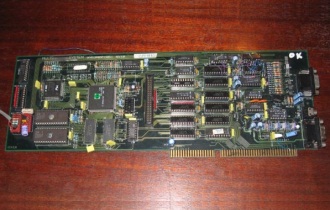
The Bali Development Kit card
This is the development board for the later MSU version of the Slipstream
chipset. It's internal project name was "Bali" and was often called, in
conversations I've had with ex-MSU staff, the Bali board or Bali system. It's
also sometimes called "Card 1".
I actually owned one of these boards which given to me by Martin Brennan.
Unfortunately - I have however lost it when I moved house. When I was
presented with the card, I was unsure what it really was and I had no
software at that time to run on it (I now have a host of test programs and
Robocod 2!). Fingers crossed I find it again and that it works!.
[Update - luckily Martin had more than one!, and has since given the Slipstream emulator programmer one].

Graphic only visible to developers
of the Multi-system 2 - Image extracted by Andy Mucho
Buried within the BIOS chip of the card is this image - it's not clear when it would be shown, and the developer's memory is a bit sketchy on this, but you can assume that when the board powers up it displays this at start-up. To be replaced later by graphics from whatever application the developers would be running on the system.
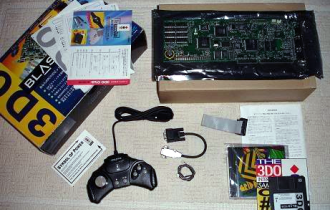
Creative Labs 3D0 Blaster card
a similar concept to the MSU dev-kit
The card itself is a self contained system much like the Creative labs 3D0 Blaster card which also plugged into a PC. The card would derive power from the PC and share the data/io bus so that software could be downloaded easily onto the card via the PC's operating system - this is a much easier and elegant way of building a development system than the Konix Multi-system 1 which had an independent board and a data transfer cable (the PDS system).
"It looks like a CD player"
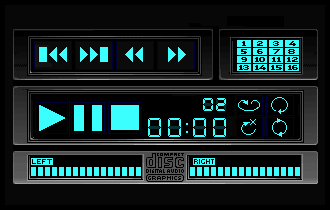
On-Screen CD player display that shows
when the video output is pumped into a TV
MSU eschewed the Slipstream controller and gone was the notion of peripherals. Speculation time: if it was a successes - they may have added these controllers and peripherals back - but this is just a guess. Maybe it was a concerted effort to get away from the controller as it did attract some ridicule. They could be taken more seriously if they offered a conventional VHS/CD player style enclosure.
Although it really doesn't matter what the box under your TV looks like that plays games, it's a shame that it had no styling. There is of course a good reason for it looking this way, and that is that the Slipstream chipset was being touted to manufacturers as a quick way for them to build a CD / VCD / Karaoke player system that could play games if desired.
The chipset was what was really being developed and sold. There didn't seem to be any requirement to include an "Intel inside" style sticker on the outside of every box like would happen in the PC world. As long as MSU had a customer that wanted to produce one million CD players or VCD players or whatever paid the license fee for using the chip - they didn't mind.
And so - the one example we see of a physical MSU Multi-system is the TXC
manufactured "TXE" system. Below is a picture of the Newstar CD interface
that I have from an archive of software a former MSU programmer has kindly
given me - this gives an idea of how the separate manufacturers would
utilize the machine and brand it their own way. I have however never seen the hardware
of this Newstar machine in person.
This image is what I assume is used as a start-up image when the CD player is
turned on - or as a bouncing logo when the machine is in screen saver mode.
Again, this is taken from the actual software - and not just a logo grabbed
from the internet. If anyone recognizes this interface and logo from a CD
player they have, I would be VERY interested in getting in touch with you to
talk about it!

Actual graphic from the operating system for the
Newstar implementation of the Slipstream chipset
CD / Games Player
This approach of building a chipset to go in an entertainment player box
to try to create a cross manufacturer standard wasn't the only time this
happened. Interestingly in the family tree of the Multi-system, the Nuon which was developed by John Mathieson of Flare, included
Jeff Minter as an excited developer and other famous names from the home
computer world, created a chipset capable of 3D games and DVD playback and
was put in a couple of different manufacturers' boxes. You could use it
exclusively as a DVD player an never really know it was a games machine - or
you could use it a s a games machine that also allowed you to play DVDs.
This
didn't really catch on. I'd imagine that it didn't spark the gaming community
into a frenzy of excitement - gamers seem to like to establish a brand
loyalty and they are pretty fierce supporters of their brand. Some
can be brand agnostic, but when you have to invest money in just one
machine, you stick with one. The Nuon, not having a strong brand probably
lead to it's demise - I'm assuming the same would have happened with the MSU
Multi-system?
Going up against Giants
So, how do you take on the might of Sony, Nintendo and SEGA? Well, let's
look at what this machine was up against. Assuming that it was to be released
somewhere around 1994 (autumn, according to the Edge magazine feature) it
would have beaten the Sony PlayStation, SEGA Saturn and the Nintendo 64 to
market - at least in the US. However, by that stage, the SNES, Genesis,
Philips CDI, 3D0, TG-16, Neo Geo, Amiga and Atari ST were all supporting a
huge library of games and had by that time all enjoyed a raft of peripherals
and add-ons to make the machines capable of CD and 3D games play (there are
some obvious exceptions to that, but the point I'm making is that these were
established, tried and tested machines with a huge library of games and lots
of developers on board).
So the Multi-system would need to be something special to compete eh? You're
right to assume that; however it really wasn't. This was the start of the 3D
era, and you HAD to be making a console at least capable of 3D with textures
and shading even if it wasn't the main focus. The experimentation with 3D
gaming on dedicated games consoles had been done with Super FX and 32X, this
wasn't just a buzzword, it was mandatory.
Bizarrely, the MSU box would have been going up against it's cousin The Atari
Jaguar. It must have been a good time to be Martin Brennan - he had his hands
in two different machines.
Unfortunately neither went on to enjoy the runaway
success of the PlayStation. It is apparent though, that the success of Sony
wasn't down to the hardware - it was a capable machine, but wasn't
necessarily the best platform. The success came from a HUGE company with a
big pot of money at its disposal for marketing and the fresh attitude of a
newcomer to the industry with the vision to make it less restrictive to
develop games for their machine than it's established competitor
Nintendo. Although new to games machines, Sony was a very well known and trusted brand in Home Electronics with an already credible reputation.
Flogging a Dead Horse?
There could have been a chance, the machine was to be released pre PlayStation (it's incorrectly written elsewhere on the internet that the PlayStation was already released). However gamers had already had their fingers burnt by the Konix Multi-system and weren't likely to be attracted so easily back to the new MSU system.
Developers with Multi-system experience were employed to work on the Multi-system 2 - We know by now that some games were rewritten for the Intel 386 and the new version of the Slipstream chip. Some new games were to be ported. It's not completely sure if they were all completed. But I believe they must have at least reached a playable beta stage - there's a story of Wyn giving MSU prototype units to friends (the ones developers were supposed to test their work with) and you can only assume they must have had CDROMs burnt with beta versions of games.
A Monumental Effort
There was a team of talented and hard-working people working on the MSU products. It wasn't for a lack of their effort that the machine failed to become a commercially successful games machine. These guys were battling against the hardware and the demands of Wyn to push the machine to do things it just couldn't do.
Young, talented developers were making this machine into a games machine
despite the upper management. Established developers were leading with their
knowledge, they were all battling against the management's desperation;
Pressure and stress are common in this industry, but being involved in a
born-again start-up with a tarnished reputation leads to even more. I have
heard stories relating to Konix and MSU similar to any business about when
things start to decay - missed payments, people expected to work for the
promise of money, lawsuits, acrimony and personality clashes.
When the ship starts sinking and it becomes a case of every man for themselves
,then you start seeing people stepping on others and all the worst aspects of
people come to the front.
This is all I'm willing to write about this aspect of MSU for fear of being sued, let's just say that I have personal accounts from people that are still very peeved by what went on and anything I recount could get me embroiled in lawsuits. They were very dark times at the end. That's not to say that everything fell apart - far from it. Although the attempts to make the MSU box into a games machine basically fell flat, the technology was still viable for other uses. There was money made by MSU, some people did make a healthy living from it. From a gamers perspective, it was a failure but as a technology, it did what it needed to.
The IBM Popcorn Project

IBM Popcorn?
(Not to be confused with an earlier codename for a PC AT from 1984).
MSU were working on a project using the Slipstream chipset for another games console which would have been manufactured by IBM nicknamed the 'Popcorn Project'. This was to be a console aimed at younger kids with two cartridge slots (I'm not sure why it would need two) and you would be able to attach peripherals such as bikes etc. Not much more is known about this project and it got canned when IBM decided they didn't actually want to make a games machine.
It's interesting that a huge corporation such as IBM would consider making a games machine in the first place - but not surprising. Being a huge corporation, it was certainly aware that there was money to be made in the games industry. I've been told that IBM had a special projects R&D lab were lots of quirky things were being worked on. Although the projects at the time were top-secret, the security of the area was apparently quite lax and several prototype systems would mysteriously disappear when the regular staff went home and only the contract cleaners were left in the building...
IBM actually manufactured the Atari Jaguar console - but this was purely a contract job and as far as I know IBM weren't involved in the design of the Jaguar, but it's interesting to see a continued involvement...
Chris Southgate formerly of MSU recalls the IBM project:
I worked on a lot of different parts of the TXC, but my biggest job when I was at MSU was lead programmer on the SDK for the IBM Popcorn. The Popcorn was intended to be a competitor to Apple's Pippin. It was aimed at little kids - 3 to 8 maybe? It had two cartridge slots, one for the game that you were playing, and the other was for additional content for that game.
One big feature of the Popcorn was that it would have 3D graphics, courtesy of the Slipstream chip. This was a really bad idea. You may have heard from other developers that the Slipstream was a bit troublesome to deal with - the biggest problem for us was that the blitter was extremely complex to set up, and took a lot of slow register writes to tell it what to do.
We were relying on the blitter to do our texture mapping, but it could only blit one horizontal line of pixels at a time without needing to be set up again. In the end we realised that for scan lines shorter than a certain number of pixels, it was quicker to use the CPU.The Popcorn died while it was still super duper top secret. I was very privileged to work for a while at IBM's office in Lexington, Kentucky, where they had a "secret lab" which was mainly concerned with game related projects which never saw the light of day. They had one of the very first Pentium processors on there, it was the first time that I had seen a CPU with a fan on it.
IBM gave us a rough spec of what they wanted in the SDK. They had based this spec on the source code for James Pond: Robocod. Some engineer at IBM who had no knowledge or interest in games had looked through it and called out the functions that he thought would be useful. We couldn't make it exactly to their spec because it was pretty much nonsense! For example, they wanted a function called ShakeScreen() which would... shake the screen. No parameters, nothing.
There was another company involved, who were to make the first games for the Popcorn. I can't remember the name of the company, but they were all from Papyrus, esteemed maker of racing games at the time. They had all quit Papyrus and started their own company.
There was a problem though. If you have read Hitchhiker's Guide to the Galaxy, you'll remember Golgafrincham Ark Fleet Ship B, which was filled with people who thought they were headed to a new planet because theirs was doomed. What had actually happened was that these people were surplus to requirements because they were a bit rubbish, and had simply been fired off into space. I think a similar thing had happened here.
These were not Papyrus's best and brightest - far from it.I recall being asked to sign off a project plan for their first game, which was to take several months, and was broken down into tasks whose duration was to the nearest 30 minutes. Also I think it emerged that nobody on their team had the slightest clue about 3D graphics. This was supposed to be a 3D game... in the end I think they abandoned the 3D and went 2D. The Popcorn hardware was no good at 3D anyway, as I mentioned earlier - it couldn't do texture mapping at any useful speed. It also had no concept of 3D itself, rather like the PS1, it couldn't do perspective corrected texture mapping, filtering, or antialiasing, but of course this was pretty normal for that time. The SS4 chip was also rather buggy and would freak out if you pushed it too hard.
I have almost no recollection of the technical details of the Slipstream chips, and I can't remember how they differed. I remember that the CPU in the Popcorn and also I think in the TXC was an Intel 80376, running at 16MHz. This was a special version of the 32-bit 80386SX which didn't support "real mode", which made it useless for PC's, as it wouldn't run DOS. I can't remember exactly why this processor was used, I'm guessing that it was cheaper than the 80386SX.
Keith Goodyer explains more:
My first recollection of the project was being put on a plane, and shipped off to their [IBM's] R&D Center in Lexington, KY. IBM had for some reason decided to get into the consumer electronics business. Then just as the product was ready to launch, there was a senior management change - and they shut down the entire consumer electronics business.
It was a twin cartridge games machine for the under 5's - There were some great accessories planed for it. A kids Trike that operated like a joystick - peddle to go forward or backwards, and steer to go left and right.
IBM wanted it to be an educational system - their thinking was parents would trust the IBM name. I guess it was far more what the Wii has become - Non-violent, family entertainment.
A product not equal to the sum of it's parts
There's something that can't be avoided with the Multi-system 2: it had the lingering smell of failure - no matter how hard the people worked on producing games for it, no matter how great they may have been (not forgetting how much hard work they had to invest to make this hardware do something impressive), the machine wasn't a triumphant return - nor was it an unequivocally impressive box. It was a chipset thrown into a boring case seemingly with no soul, passion or any attempt to actually tempt people to use it.
It was bog standard, boring and generally lacking in most respects. It's a real shame that so many people worked so hard on it, but it was a combination of fast buck business mentality, lack of care and attention to detail (and maybe a lack of Attention to Detail (The company)?).
It had defeat written all over it and without the unique selling points of the mad peripherals, the crazy design of the controller and the care to make this a machine for gamers rather than to try to ride the wave of multimedia (ugg, I feel dirty even typing that 10 letter curse word) it was doomed to fail.
You can't paint a games machine to life by numbers, there has to be something about it, even if it's only that it's cheap and available, the 8 bit micros (at least the Spectrum) were cheap and available and it saturated the British market and therefore guaranteed a development community would make games for a machine that's in most homes. And of course - there was no Hype. None.
The Multi-system you can own
Believe it or not - this isn't vaporware, you can own a MSU(TXC) Multi-system. However - the challenge is to actually find one these days. The unit was sold - at one stage you could walk into a RadioShack/Tandy and buy one off the shelf. Unfortunately I don't know if it was branded as a RadioShack brand or TXE, but Geoff Philips, one of the MSU developers clearly remembers walking into his local Tandy and finding one for sale.
As far as I know there is no released software. Although something must
have been available. The system bears a striking resemblance to the Tandy
Memorex VIS which was available in Tandy/RadioShack.
This system bombed totally due to the misguided idea that parents controlling
what little Jack and Jill are playing (ensuring that there's educational
software and family friendly games) will sell machines. This approach has
never worked. If anyone has one of these TXE machines, please contact me -
I'd love to hear about it.
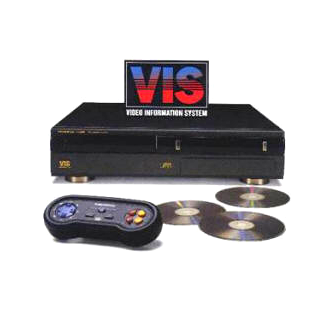
Memorex VIS - a system VERY similar to
the TXC Multi-system in concept
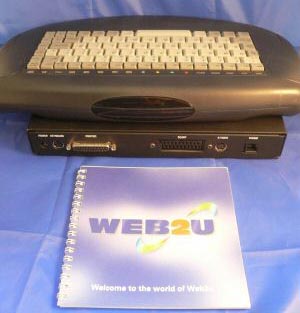
The Web2U (MSU) internet set top box,
using the SSv4.5 chipset
Creating an internet Device
Almost everything talked about above has been regarding games - and that's quite understandable as The Konix Multi-system that paved the way for the above developments was a games machine and nothing else.
It was Keith Goodyer however who was exploring what could be done with the Slipstream chipset, and it's his efforts that paved the way for MSU's real success.
This little passage from a chat I had with Keith explains how MSU got into building internet devices:
Slipstream
Was there ever a clear plan for using the Slipstream Intellectual Property,
or was it all quite opportunistic? A games machine, a VCD player with games
capability and an internet Set-Top-Box seems to be milking the most out of it
possible. I guess it was your job to see how this could all work?
Keith Goodyer
That's exactly what I ended up doing. By the time I came to the project
Nintendo and SEGA had already got a hold on the console market. So I came up
with different things to do with the 'SlipStream' and other technologies,
like the Winbond MPEG decoder we had licensed, and Martin's ENVOY CD chipset.
It was all rather opportunistic. The 'net had just started happening, and I
saw a BIG future in on-line.
That's where the net box idea came from - Multi-system hardware + Modem +
TCP/IP Stack and a Browser.
The internet set-top-box idea of using the Slipstream ASIC to make a cheap and easy internet access device was brilliant; internet STBs may not be the huge hit that the cell phone or iPod were, but they have their place and are still in use (mostly in hotels) around the world. Of course it was a fiercely competitive market where obscure manufacturers could strike it lucky on basic performance and competitive price points, and there was no clear leader, but it's nice to know, that the little Slipstream ASIC was the catalyst.
Some pictures of MSU's Slipstream (Multi-system ASIC based) internet set-top-box:
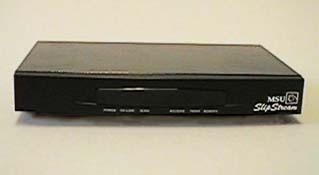
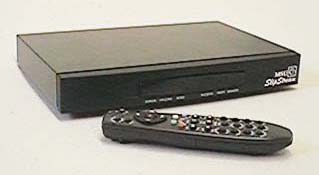
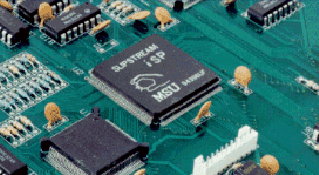
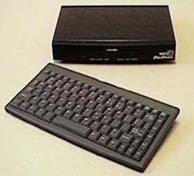
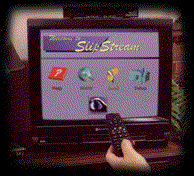
If someone has access to one of the Slipstream internet set-top-boxes, then I'd love to see one. If it's a working unit, then it's a good way to get our hands on a later revision Slipstream ASIC. However, it could teach us a lot about the capabilities, and would be a good way to try to run code on a real device.