
Content
Multi-system Overview
The Slipstream Controller
It's a bold claim that the Multi-system had revolutionary controls - as after all we had seen Steering Wheel Racing Controllers, Flight Yokes and Bike Handlebars already in the Arcades and even to some extent in the home. The revolution was in the combination of the three, and it's the elegance of the system that allowed it to morph between the setups that was the brilliance of the design. Add to this some quite refined and tasteful styling (this was the 80's after all, think what it could have looked like!) and you've got the basis of a great product in it's own right.
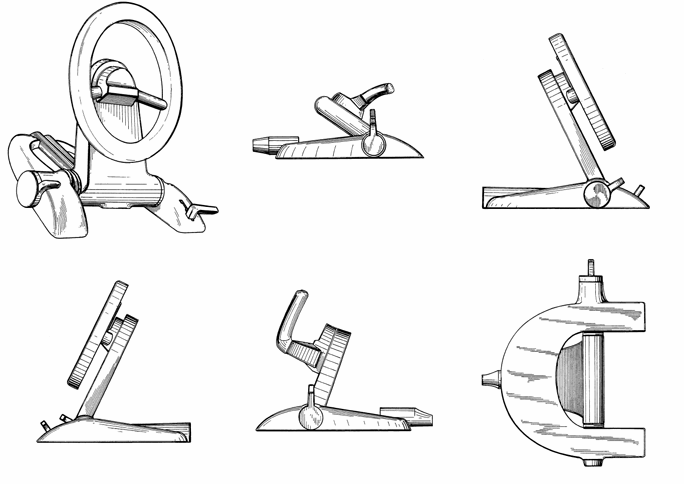
Images from Slipstream Patent.
Click picture for more info
If it were to be sold as a games controller only, the Slipstream controller, as it was code named, would have been a little tricky to adapt to be suitable for all the games machines of the time. Unfortunately in the world of computing and gaming there are too many standards, and Konix would have had to have either made some quite clever electronics to adapt the system to interface properly with each possible games machine, or they would have had to make a separate Slipstream controller specifically for each games machine - either way both difficult pills to swallow. This was already seen in the case of their successful joysticks for the various home computers such as the Speedking and Navigator.
The line art images presented on the website are from one of two patents
filed for the Slipstream controller - I have hunted quite hard and can only
find patents for the Slipstream Controller - not the Multi-system as a
whole.
It would be great to see some patents for the Light Gun and the infamous
Power Chair too - but alas I can't find them, maybe someone else with better
patent hunting skills can help? There are several subtly different revisions
of the design knocking around, some of them seem to have existed before the
decision to put the Flare One electronics into the case were made.
Thanks to Product partners (the later venture entered into by some of the Level Six designers), we have a glimpse of what was also on the drawing board. I don't know for sure what was going on here - I believe the patented design we are all familiar with pre-dates these sketches. As the style of these sketches is very much in keeping with the Chair and Gun concepts adopted by Konix, it's possible that Level Six were asked to provide alternative designs prior to production. Certainly the conventional Slipstream controller is a unique design capable of standing on it's own. It doesn't have the Sci-Fi B movie appearance of the other Level Six Concept sketches and therefore I believe it was Wyn's own already recognisable iconic design that was kept for mass production.
-
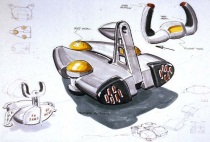
Console concept Image 1
© Product Partners -
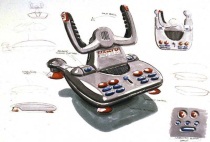
Console concept Image 2
© Product Partners -
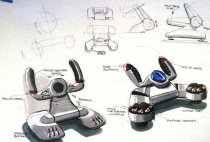
Console concept Image 3
© Product Partners -
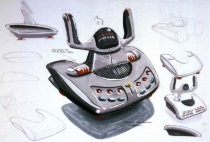
Console concept Image 4
© Product Partners -
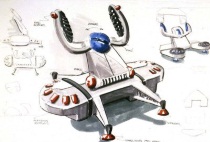
Console concept Image 5
© Product Partners -
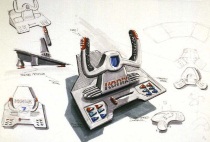
Console concept Image 6
© Product Partners -
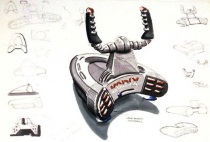
Console concept Image 7
© Product Partners -
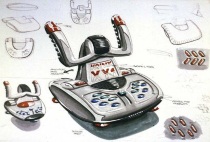
Console concept Image 8
© Product Partners -
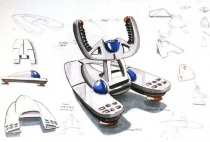
Console concept Image 9
© Product Partners -
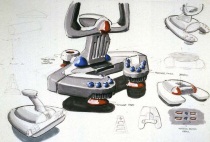
Console concept Image 10
© Product Partners -
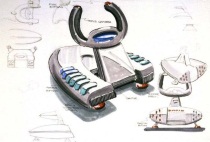
Console concept Image 11
© Product Partners
The Electronics
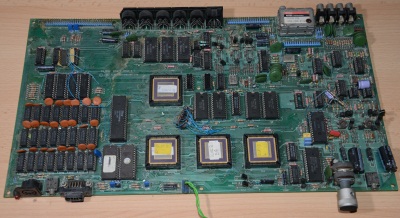
Flare One Prototype
The electronics behind the impressive technical demos were created by
Flare Technology. They were the basis of a computer system which was intended
to be as powerful as the Commodore Amiga 500, but cheaper to make.
They called their system Flare One and it was in some ways derived from the
fabled Loki project although it was more an evolution of the ideas the guys
originally had for Loki than any actual further development of the Loki
intellectual property.
Flare had designed this system independently of The Konix Slipstream, and were keen to sell it to manufacturers. They did actually sell it to BellFruit, a British manufacturer of pub quiz machines and one armed bandits. It's quite interesting to see the technology in action - and in effect, owning one of these arcade machines is as close as you'll probably get to owning a real Multi-system. They can still be purchased on eBay these days - but it's a bit of a mission tracking one down.
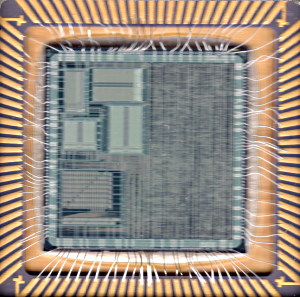
Inside the Slipstream ASIC
The Flare One prototype system was further developed specifically for Konix and as such the chipset which comprised of four custom processors were integrated into one chip and the processor was changed to beef the system up a bit. The opportunity would have been taken to fix a few issues and make some subtle changes to the way the ASIC works which if more code or technical documents become available may become more clear over time. If you'd like to know more about this, then please read Simon N Goodwin's in-depth Multi-system write up, and download a copy of the actual Konix Multi-system technical programmers reference manual.
The custom chipset of the Konix Multi-system was a contributing factor to
its strength, just as the ULA, the SID and VIC chip, The Super FX chip, the
Copper and Blitter chips and all the custom silicon that made other machines
do what they could above and beyond the use of off the shelf parts, the Flare
One's strengths lay in the 4 custom chips which later became the single
merged ASIC that the Konix Slipstream employed. This chipset later went on to
be called the Slipstream chipset. The Konix version being SS 1
(SlipStream 1) and later MSU revisions getting up to SS
4.5
Specifications:
Memory:
128K RAM - later it would be upgraded to 256K
RAM after complaints from developers.
An optional 512K RAM cartridge was considered to boost the total RAM for the
machine to 768K.
In this day and age - this seems like a stupidly small amount of RAM. But
you must remember that back then, RAM was VERY expensive and often it was the
most costly part of any games machine.
In the case of the Konix, it was more costly than either the CPU or the
custom ASIC.
(N.B. at time of writing, Wikipedia has this wrong - it says the machine was
256K later to be upgraded to 512K - this is wrong as the dev-kit I have
proves (as does the documentation.)
Graphics:
4096 colour pallete - This is up to 4096 colours, in
a particular low res mode (similar to the Amiga's H.A.M. mode) all these
colours could be displayed. It would have been the case that most games would
have been run in 256 colour mode - but there are many Amiga and VGA games
that look beautiful in this mode.
It was always Flare's and Wyn's intention to try to compete with the Amiga
500 - this magic number of 4096 colours was decided upon to try to match.
The Resolutions that were offered were: (hi res) 512x200
with 16 colours, (low res) 256x200 with 16 colours and the
much more useable 256x200 256 colour mode.
Unfortunately, there was no native 320x200 resolution mode which would have
been a real boon for porting arcade games to home computers.
Audio:
Supposedly The DSP was capable of producing up to 25 channels of
stereo audio - but realistically, most games wouldn't manage much
more than 8 channels of audio. You have to consider that memory was the
bottle neck here - and you had to build all of these separate data streams
that constituted the audio channels up in memory before passing them through
the D to A chip to produce audio.
In a demonstration mode (i.e. not playing a real game, just showing a black screen and playing music), you could probably have produced something like this - possibly with synthesized tones - but certainly not using samples instrument sounds as they would have taken too much memory.
Processor:
It started life with Flare as a Zilog Z80. Konix wanted to compete with the
16 bit machines, so decided upon an Intel 8086 running at
6MHz. The 8080 that was used in the dev-kit was effectively
3 times slower (Jeff Minters estimation) than the final 8086 that was going
to be used, but was code compatible.
Storage:
880K Floppy disk
The Flare One was to use a floppy disk from the start, the Bellfruit Flare
One based arcade system used a Floppy disk and some ROM storage. The Konix
Multi-system however initially was going to use ROM cartridges. This was soon
dropped probably once Konix had worked out the costs of manufacturing
cartridges against floppy disks. There would also have been an aspect of
keeping the cost down for the consumer to make the machine more
competitive.
Konix were aiming to sell games at 14.99 pounds.
Speaking with Wyn and reading in ACE magazine, there was supposed to be a proprietary anti-piracy measure built into the floppy disk technology they were going to use. I really don't think this was the case, it may have been the intention, but short of having a proprietary data storage format which basically wrote raw data to the disk, I have seen no evidence of such a measure.
The Peripherals
The Power Chair
The peripherals are almost worth an entire website themselves - due to the ambitious nature of the level of interaction Wyn was trying to offer and the novel ways he was trying to accommodate that interactivity in mostly affordable and easy to manufacture components. It's purely down to a lack of personal accounts and any real supporting documents or evidence such as blue prints and specifications that I can't elaborate on them any more here. Hopefully once more people read the site, accounts and documents may come rolling in.
It's safe to say that the Power Chair was probably the one thing about the Multi-system that made your jaw drop to the ground. It was also possibly the straw that broke the Camel's back. It really was probably a step too far in hindsight.
If the notion that you could add a relatively cheap powered moving chair to your home games system came along maybe after a year of the Multi-system being released, then who knows where we'd be now.
It certainly wasn't an impossible dream - the darn thing existed and functioned as was intended - there is photographic evidence in the pictures just below this paragraph. But it was a case of gilding the lily - I think it pushed the Multi-system from being a credible project to something too awesome to handle.
Apparently, and this comes from a former MSU employee, the Power Chair
used a 6502 8-bit processor! I don't recall seeing anything in the press or
anyone else's accounts that mention this level of complexity of the chair
design.
I'd assumed that it was just a simple matter of a control line or two driving
a relay and maybe some feedback relating to position provided by reading the
value of a potentiometer. This makes me even more curious to see a real Konix
Power Chair.
Here we see a number of people using the Power Chair, there are also two versions of the chair on show, one more open than the other. According to the company that built the prototype, the more triangular enclosed seat is version 1a and the more square design with open sides was version 1b.
 "An empty Power Chair")
 "Jeff Minter Gun in hand, Multi-system in other, Power Chair between legs")
 "Enjoying the Power Chair experience")
 "Ed Semrad")
 "Unknown Rider")
 "Unknown Rider")
 "Wyn Holloway posing on the Power Chair")
In the pictures we can see Jeff Minter, Wyn Holloway, Matt Bignell and Ed Semrad. If you are one of the other 3 please drop me a line, I'd love to hear your impressions about the machine. Also, any members of the games industry, press or public who attended any of the shows where the Power Chair was present, and if you managed to ride the Power Chair please get in touch.
 "Thunderblade!")
 "Power Chair Add-on")
An add-on (perhaps a logical one) to the Power Chair was to be a Helicopter style joystick.
I've only ever seen the artists impression from the promotional literature so I'm unsure of exactly how it would have fitted to the Multi-system's Power Chair but it's not too hard to imagine.
There is no visible locating area on the Power Chair images that I've seen, but I'd imagine it really can't be too hard to devise a system that clips onto the foot tray at the base of the Multi-system. Then of course, you'd have an unsightly cable dangling. Although a natural addition and quite a sensible one, this is probably yet another case of Wyn's imagination running away with him and the reality of the situation is that if it did come, it would come later on.
This of course was intended to turn your Power Chair into an equivalent of the Thunderblade arcade machine for the home.
Modern Power Chairs
It's been a long time since Konix tried to bring the thrills of the arcade home, but the desire for arcade style thrills never went away when the dream that Konix were trying to sell faded.
There are several solutions to fulfil the desire for a Power Chair, and they really do look effective - utilizing the correct hydraulic actuators, and clearly a complex control system to manipulate the rider in the chair the correct way.
4DOF Motion Sim
http://www.motion-sim.cz/
BlueTiger Full-Motion Racing Simulator
http://www.bluetiger.com/bluetiger.html
I'd love to have a go on one of these - and the great thing is you can go out and buy one however, as was the case with Konix, the reality is different to the dream in as much as if you think you can affordably go out and buy one of these machines then think again, they cost the equivalent of a small family car...
Light Gun


The Light Gun was quite an impressive design, being able to be adapted
into a rifle or to be a hand held pistol, It had a 50's B movie styling and
was an obvious blue. This made it less likely to be used in a successful bank
job, but more likely to be shown on America's Dumbest Criminals if it was
used in this way.
The recoil action would have preceded the Nintendo 64's rumble feature and as
such makes it more obvious that this kind of feedback is both useful and
necessary - almost every controller has a rumble facility built in these
days.
Here are some of the Concept Sketches for the Light Gun from Level Six Design (who produced the concept for the Power Chair):
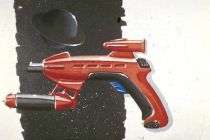
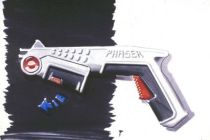


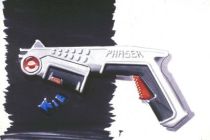



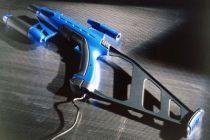

It's interesting to see these images for two reasons - One: It's interesting that it was Level Six design that produced the concept sketches that Konix would use and not Konix themselves (more specifically Wyn). Two: It's also interesting to see which design was chosen to become a physical prototype.
Skiing Simulator
Now we're into real "Pie in the Sky" territory. Peripherals like this may sound great for a few seconds but they are a clear indication that the designer doesn't fully understand the market (sorry Wyn!). These narrowly focused game-specific peripherals are like concrete Wellingtons/Galoshes. A game will sink without trace quicker than you can say "Al Capone" if it's been designed to run solely with a piece of apparatus such as a pair of electro-mechanical skis.
It's not so much that the idea of interactivity isn't a good one. Of course, the Slipstream controller and Light Gun are good examples of peripherals that have some sort of life span. But even then, you can draw a parallel with the SNES Super Scope. A handful of games were developed for this shoulder mounted drainpipe. And the usual problem for game designers occurred with supporting the peripherals of not knowing how many people had them - or even worse, knowing exactly how many people had them and it not being sufficient to be economically viable to produce the game.
Foot Pedals
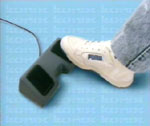
Essential for driving games, a plastic lump with a couple of pedals actuating potentiometers. Puma pumps weren't essential!
In both the MSC plastic joystick and the prototype Case I have, the pedal is remarkably simple. But then this isn't exactly something you can over engineer. it would have been enough to have a spring loaded pedal actuating a potentiometer - and that's exactly what you had with this.
The only thing missing is the clutch - but then that's quite rare in arcade racing games anyway.
Konix Number Pad
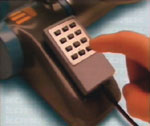
Ahh, the number pad, where would we be today without the number pad in gaming. Oh - hold on a minute - we don't use them these days. That's right, they were pretty useless weren't they.
From the Atari 2600 and a few other outings in-between (including the Konix's natural successor - the Atari Jaguar) the notion that one or two buttons on the joypad/stick device wasn't enough was addressed by early designers by offering a button pad with usually no less than 9 buttons - sometimes more.
We are in a position now where we have usually around 10+ ways of influencing the game through a button press or a d-pad action or an analogue stick waggle. The evolution of pad design has recognised that this isn't essential as better in game menus and data input systems have removed the need for these devices.
Special Edition Navigator Joystick
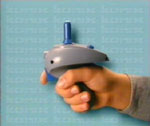
Bundled in with the Multi-system was to be a nice colour coded version of the Navigator Joystick. Probably chosen for its look more than function - after all, the Speedking was by far the more popular Konix Joystick.
This free Joystick would have allowed players to play all the regular games that didn't require the more exotic Slipstream controls.
This version of the Navigator was released as a limited edition after the Multi-system failed and still turn up on eBay occasionally.
Keyboard
Wyn Holloway had the notion that he could allow people to make use of the Multi-system as a home computer to encourage budding bedroom coders to write games for his system and of course to keep it alive and viable. I've not seen any drawings or pictures of any prototypes - so I think it's fair to say it was just a notion.
The Multi-system would have fared better as a console anyway - it would have sent out confusing mixed messages at launch if a keyboard was released alongside the machine. The machine's reason for existing was purely as a games machine - not a home computer like so many before it.
Most home consoles have actually had a Keyboard and often a Printer and Modem available as accessories, although most regular gamers wouldn't know this - it's normally the extreme collector that's interested in buying these novelties for their collection. Needless to say they didn't set the world alight.
Rowing Machine
Well, Wyn couldn't really help himself with his plans to take over the world of Video Gaming, and I'm sure the Konix Multi-system could well have been an appropriate machine to accommodate such a peripheral as a Rowing Machine with a multitude of sensors.
It's not like this isn't technically possible to build, they exist in some Gyms around the world, however they are SO specifically just for one style of game that there would be little point in a manufacturer seriously considering going to the effort of designing, building and selling an item such as this that it makes the whole idea another example of a limitless dream.
Exercise Bike
Annnnnnnnnnd... Finally! Yes, you've guessed it, we are in such a free thinking, 'Blue Sky' Roller coaster ride of what COULD be made as an add-on for the Multi-system that we're basically just throwing ideas out there left, right and center. Alarms bells were already ringing a long way up this page...
Realistically, the Power Chair should have been the statement piece for the 'WOW!' factor and Wyn should have left it there. After all, where was this ever going to end, when was some proper strong direction going to come into the picture? What would have been next? A Bus simulator, maybe a Canoe simulator, or perhaps a Broom and Crystal Slipper attachment for a Cinderella game...
There comes a point where you really have to hold back and that apparently was never part of the plan for Konix. You just can't have an add-on that simulates every possibly real-world scenario, that's silly. I'm not even making this stuff up - the Exercise Bike and the Rowing machine were actually mentioned by Konix as products planned for the Multi-system.
Colour Scheme
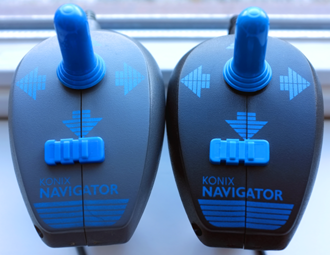
What do you think? Gray or Black?
I know which one I prefer...
In all the pictures you see of the Konix Multi-system, it has to be said
that the machine looked much better in it's light gray with red and pastel
blue highlights (such a popular 80's colour scheme!).
Instead of being sexy, the MSC controller just doesn't look as good when put
next to images of the original. It just looks cheap.
A couple of years into the products lifetime and it may have received a
makeover or a revamp. Konix may have (as do other manufacturers) offered a
redesigned black version. I don't think I'd have been at the front of the
queue to buy it myself.
I have seen other pictures of prototype Multi-systems where they appear to be
undeniably black. Even trying to explain away any kind of discolouration
through photographic chromatic problems, they are black. I imagine Konix must
have tried different colours and types of plastics.